Ask ten 3PL owners how they get new clients and eight will say “referrals and word of mouth.” That works — until the month it doesn’t. If your pipeline depends on someone else deciding to mention you, you don’t have a pipeline. You have luck.
This guide ranks the seven realistic lead generation channels for SME 3PLs and fulfilment providers in 2026 — by cost, speed and effort — so you can pick two and actually work them, instead of dabbling in all seven and winning none.
The Only Three Numbers That Matter
Before comparing channels, know what a client is worth to you. For a typical SME 3PL:
- Average contract value: an e-commerce brand shipping 500–2,000 orders/month is worth roughly £15,000–£60,000 per year in fulfilment revenue
- Contract length: switching 3PLs is painful, so clients stay 2–4 years on average
- Lifetime value: £30,000–£200,000+ per won client
That last number is why “lead generation is expensive” is usually backwards thinking. If a client is worth £50,000 over their lifetime, spending £500 to win them is a 100x return. The real question is never the cost per lead — it’s the cost per won client, and how long the channel takes to produce one.
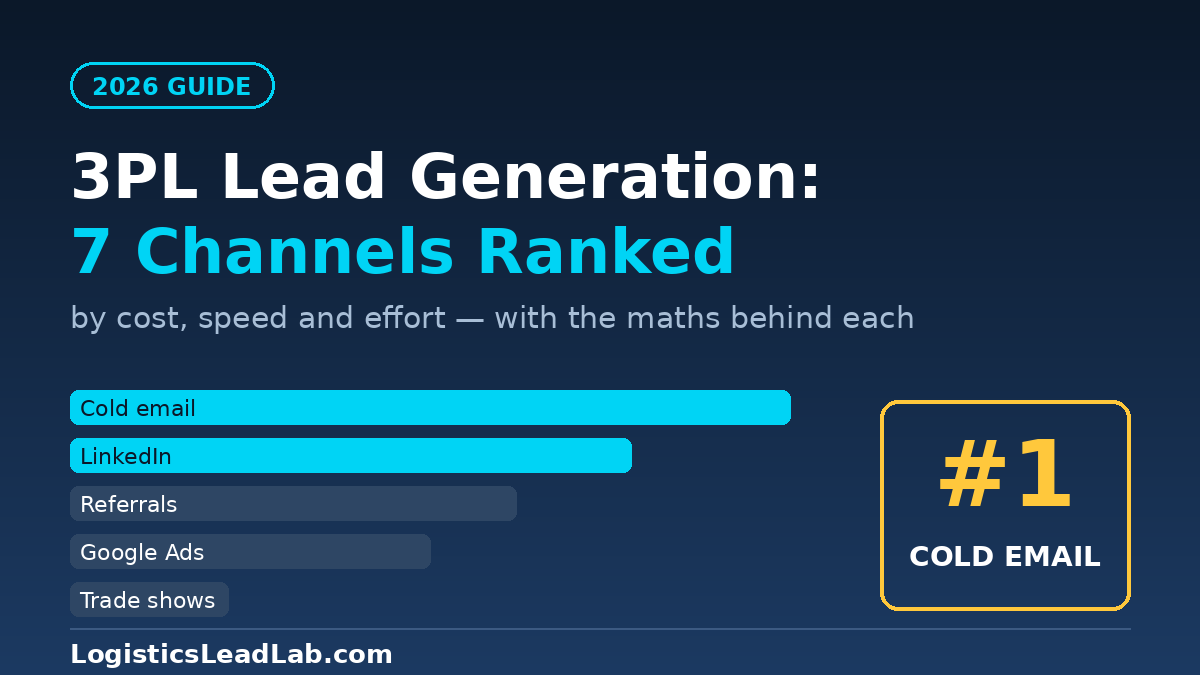
The 7 Channels, Ranked
The maths below is illustrative and deliberately conservative — based on SME volumes, UK market, and doing the work properly rather than spraying. Your numbers will vary; the ranking logic won’t.
| Channel | Typical cost to first client | Speed | Effort |
|---|---|---|---|
| 1. Cold email | £100–£500 | 2–8 weeks | Medium |
| 2. LinkedIn outreach | £0–£300 | 4–12 weeks | Medium-high |
| 3. Referral system | £0 + commission | Unpredictable | Low |
| 4. Google Ads | £500–£2,000 | 1–6 weeks | Low-medium |
| 5. SEO / content | £0–£1,000 | 6–18 months | High |
| 6. Marketplaces & directories | £50–£500/month | 2–12 weeks | Low |
| 7. Trade shows | £2,000–£10,000 | 3–12 months | High |
Why Cold Email Wins for SME 3PLs
Cold email tops the list for one reason: it’s the only channel where you choose exactly who hears about you, this week, for pennies per contact.
The economics are simple. A well-targeted list of e-commerce brands, a properly warmed domain, and a short relevant message gets 40–60% open rates in this niche (we see this consistently on our own campaigns). From 200 well-chosen contacts, expect 5–15 real conversations. One or two of those become proposals. At SME contract values, a single win pays for a year of the entire channel.
The catch — and it’s a big one — is that “well-targeted” does the heavy lifting in that paragraph. Cold email to a scraped, unverified list doesn’t just fail; it burns your domain reputation and poisons the channel for months. The list is 80% of the result. Which is exactly why we built our UK e-commerce brands database — verified brands actively shipping volume, with decision-maker contacts, so the targeting problem is solved before you write a single line.
If you’re doing this yourself: start with 20–30 emails per day maximum, one clear ask per message, and follow up twice. Most replies come from the follow-ups, not the first send.
LinkedIn: Slower, Free, and Underrated for DACH
LinkedIn outreach converts slower than email but has two advantages: your profile does passive selling while you sleep, and in markets like Germany, Austria and Switzerland — where cold email regulation (UWG) is stricter — it’s often the primary compliant channel.
The playbook that works: optimise your profile so it reads like a landing page for e-commerce brands (not a CV), connect with 10–15 operations or founder profiles daily with no pitch, then message only the ones who accepted, referencing something real about their brand. Volume kills this channel; relevance feeds it.
For DACH specifically, pair LinkedIn with a verified DACH brands list to know exactly who to connect with instead of guessing from hashtags.
Google Ads: Fast Data, Expensive Clients
Search ads put you in front of brands actively looking for fulfilment — the highest intent traffic that exists. The problem is everyone knows it: fulfilment keywords in the UK run £3–£8+ per click, and a client can easily cost £1,000–£2,000 in ad spend once you account for the clicks that go nowhere.
Our honest take: Ads make sense as a data channel first. Even a small test budget tells you which search terms real buyers use — intelligence you then feed into your SEO and your outreach messaging. As a primary acquisition channel it only works once your close rate is solid, because every lost proposal is money burned.
The Channels That Quietly Waste Your Year
SEO is real but slow — 6 to 18 months before meaningful inbound. Do it, but as a background asset, never as your survival plan. One useful post per month beats twelve thin ones.
Directories and marketplaces (fulfilment matchmakers, “find a 3PL” platforms) deliver leads that are shared with four competitors and shopped on price. Fine as a top-up, dangerous as a strategy — you’re building someone else’s brand with your margin.
Trade shows can work for larger 3PLs hunting enterprise contracts. For an SME provider, £5,000 spent on a stand is 10–50 cold email campaigns’ worth of budget for a handful of business cards. The maths rarely closes.
What We’d Actually Do With a £500 Budget
If we were starting a 3PL pipeline from zero this quarter:
- Weeks 1–2: Get a verified list of brands in your sweet spot (region, order volume, product type). Warm up a separate sending domain.
- Weeks 3–8: Send 20–30 targeted emails a day. Two follow-ups each. Log every reply and objection.
- In parallel: 15 minutes of LinkedIn daily — connect with everyone you email. The second touchpoint doubles reply rates.
- Week 8+: Take what buyers actually said and turn it into one solid SEO post per month.
Not sure whether your operation is ready for the volume this brings? Run it through our free 3PL Readiness Calculator first — two minutes, no email required.
And if you want the targeting problem solved today instead of in six weeks of scraping: our membership gives you every verified UK, DACH and France e-commerce brand database we maintain, updated continuously, for less than the cost of one bad directory listing.